
Spiking Neural Network Control of a Flapping-Wing Robot on Resource-Constrained Hardware
Published in 10th Annual Conference on Robot Learning, 2026
Preprint Spotlight
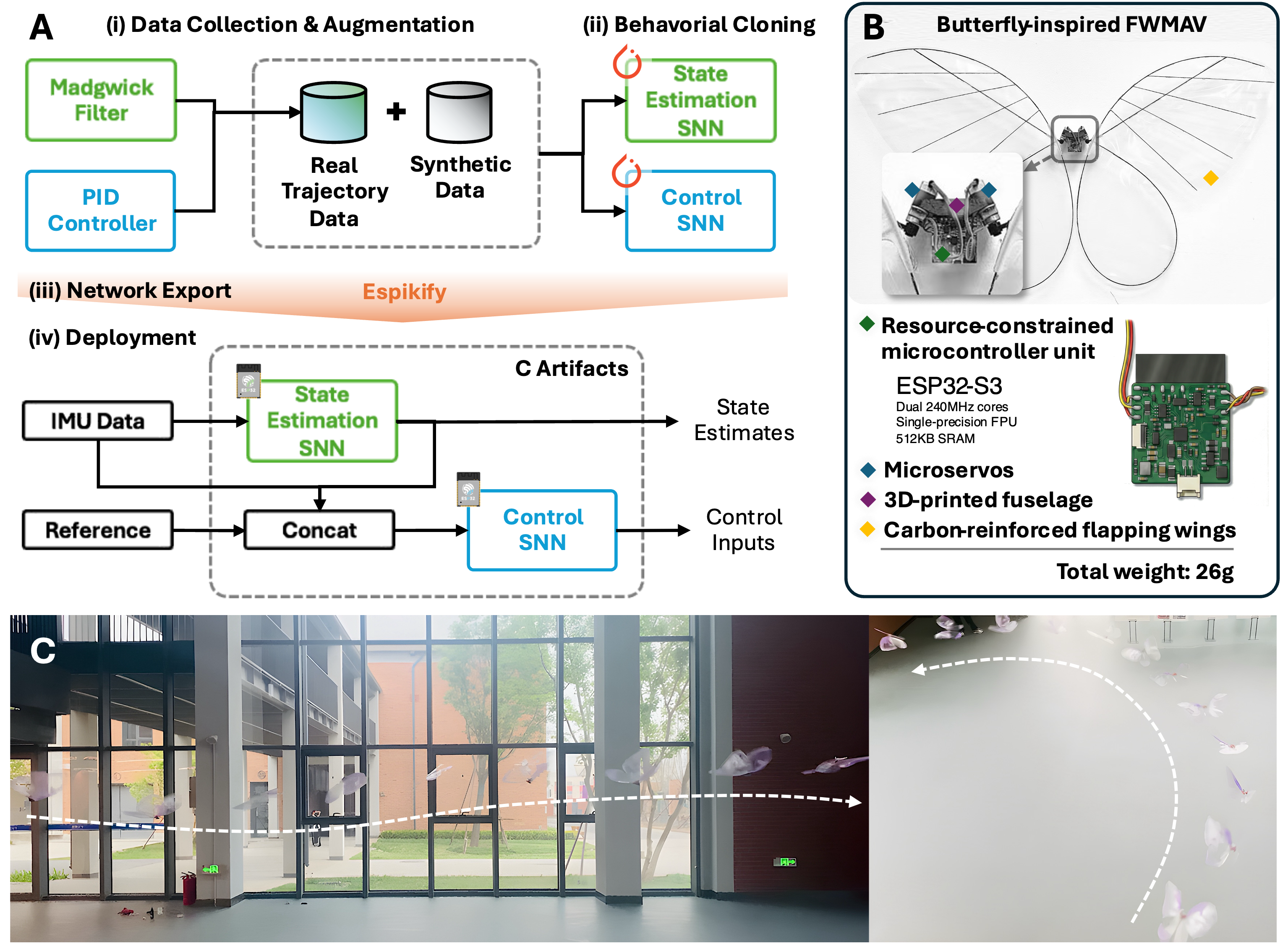
This work presents a hierarchical neuromorphic control framework for a flapping-wing micro aerial vehicle under severe onboard computing constraints. The system deploys lightweight spiking neural networks on an ESP32-class microcontroller for state estimation and closed-loop control.
Why This Matters
Small flapping-wing robots face strict limits in payload, power, and onboard computation. Conventional neural controllers can be difficult to deploy directly on such platforms. Neuromorphic approaches offer a biologically inspired alternative that may reduce latency and power while preserving responsive behavior.
Main Contributions
- Proposes a hierarchical neuromorphic control framework for a flapping-wing micro aerial vehicle.
- Deploys two lightweight spiking neural networks onboard: one for state estimation and one for control through central-pattern-generator modulation.
- Trains the controller by imitation learning and evaluates closed-loop pitch and heading tracking in untethered flight.
- Demonstrates spike-based computation on a low-cost, widely available ESP32 microcontroller rather than specialized neuromorphic hardware.
Key Findings
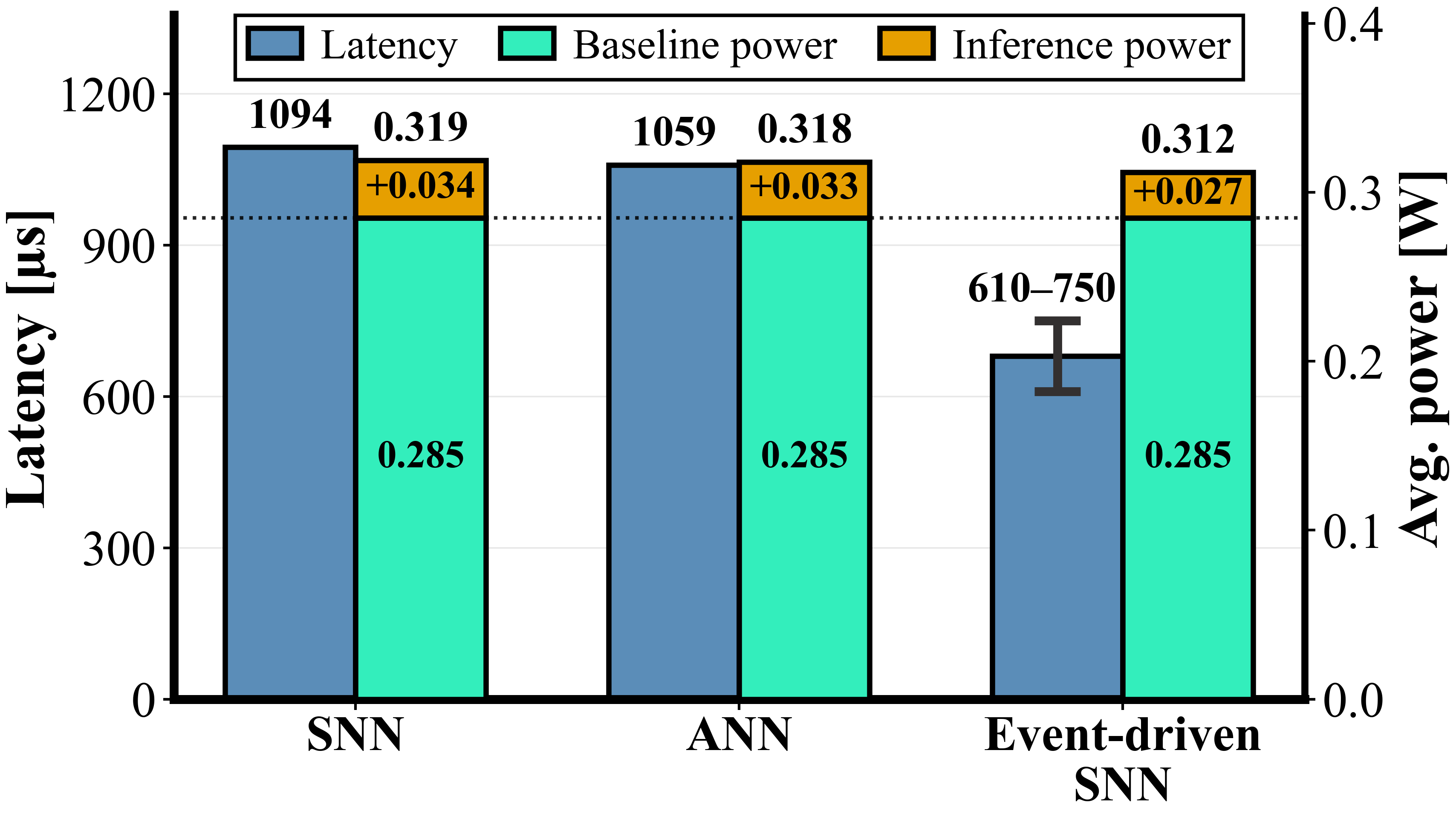
- The SNN-based controller reduces reported inference latency from 1059 us to 680 us relative to an ANN baseline.
- The SNN-based controller reduces reported inference power from 0.033 W to 0.027 W relative to the same baseline.
- The experiments demonstrate fully onboard neuromorphic control for autonomous flapping-wing flight under stringent SWaP constraints.
Citation
El Filali, Rim, Chenrui Feng, Chao Gao, and Weibin Gu. “Neuromorphic Control of a Flapping-Wing Robot on Resource-Constrained Hardware.” arXiv preprint arXiv:2605.19430 (2026).