
Koopman Identification of Nonlinear Systems via Reservoir Liftings
Published in IEEE Control Systems Letters (Accepted for presentation at IEEE CDC 2026), 2026
Paper Spotlight
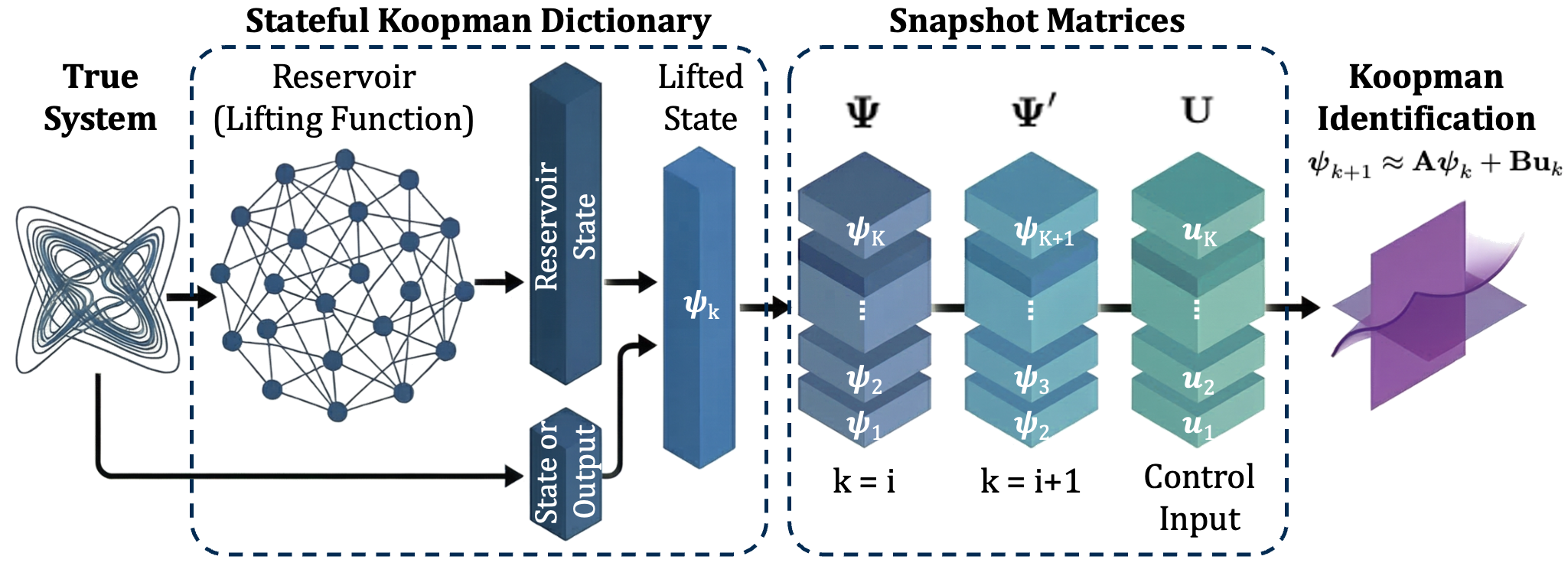
This work introduces RC-Koopman, a Koopman identification framework that uses reservoir dynamics as a stateful lifting dictionary for nonlinear dynamical systems. The key idea is to let the reservoir encode fading-memory histories while a finite-dimensional Koopman model is identified by linear regression.
Why This Matters
Koopman operator theory offers a principled way to represent nonlinear dynamics through linear evolution in a lifted space. In practice, however, performance depends heavily on the choice of observables, the treatment of memory, and numerical conditioning. RC-Koopman addresses these issues by using a reservoir as a stable, history-dependent dictionary.
Main Contributions
- Formulates reservoir dynamics as a stateful Koopman dictionary whose memory depth is controlled by the reservoir spectral radius.
- Uses the Echo State Property to support well-posed lifted representations and improve numerical conditioning.
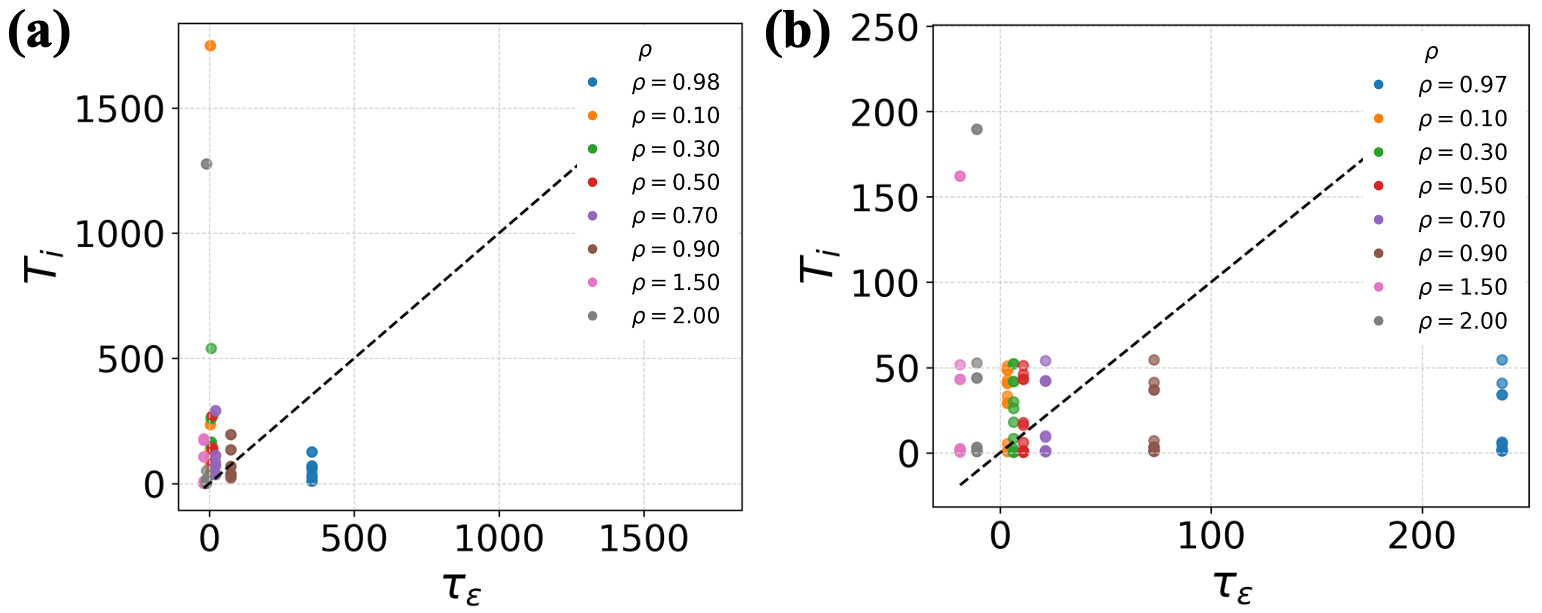
- Provides a correlation-based spectral-radius selection rule that aligns reservoir memory with dominant system time scales.
- Characterizes how finite reservoir memory affects which Koopman eigenfunctions are observable from the lifted features.
- Evaluates the approach against EDMD and Hankel/HAVOK-style lifting on nonlinear benchmark systems.
Key Findings
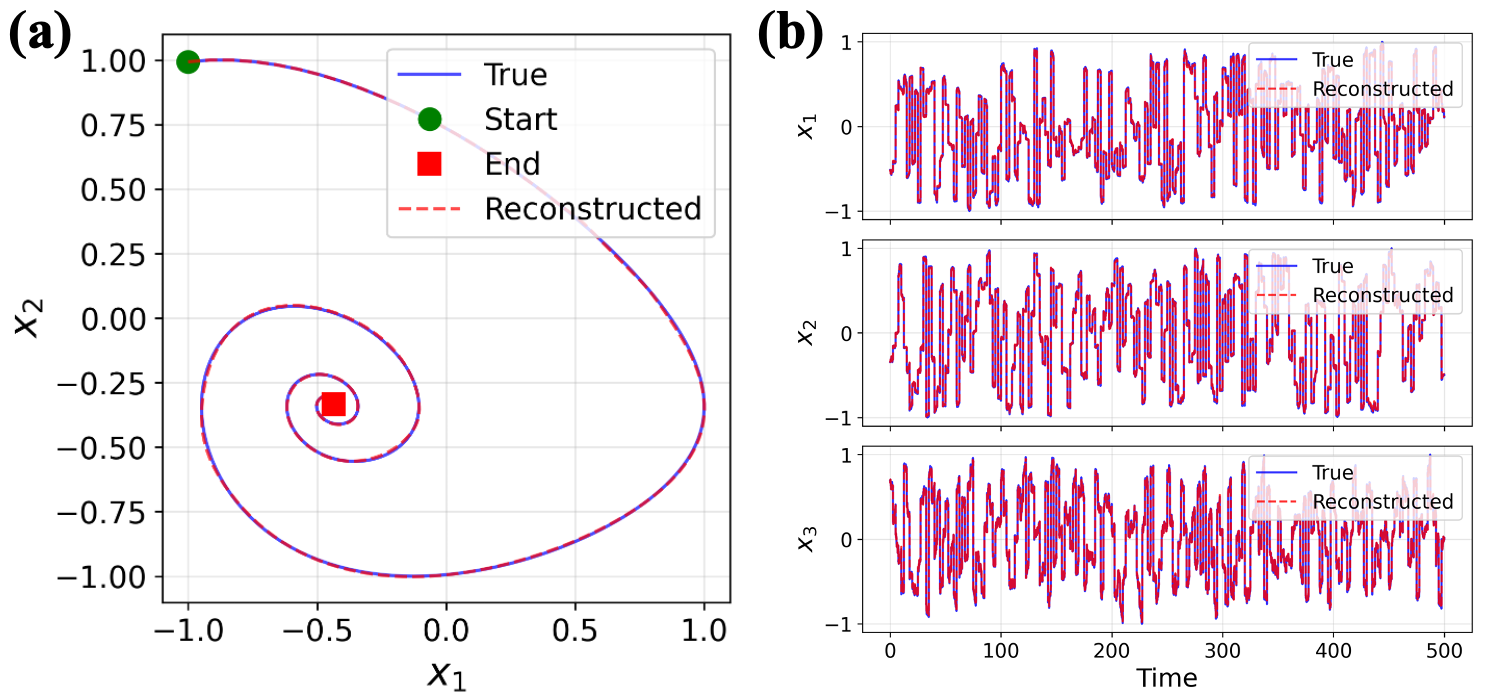
- RC-Koopman achieves a practical balance between reconstruction accuracy and dynamical stability.
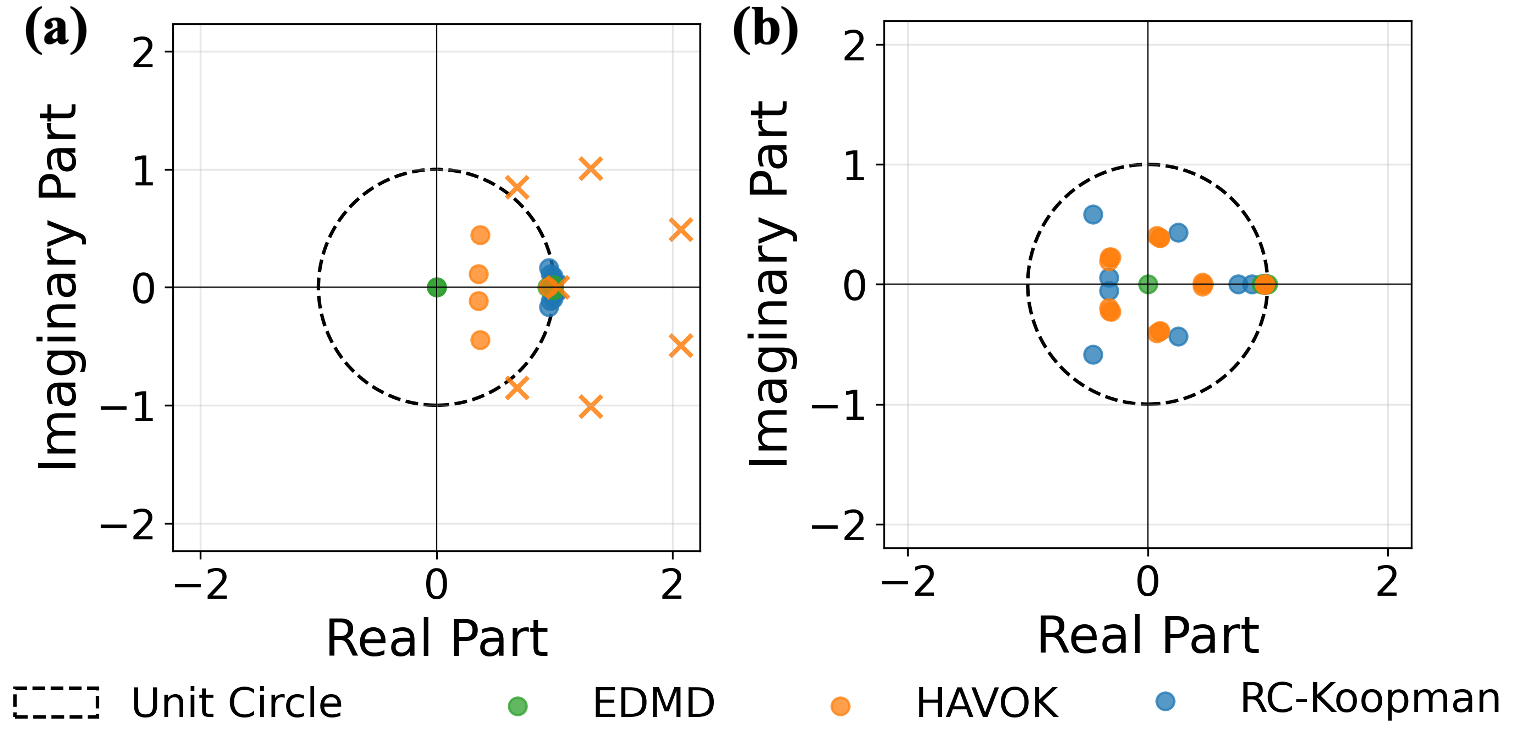
- Reservoir liftings produce better-conditioned feature representations than ill-conditioned dictionary or delay-coordinate alternatives in the reported benchmarks.
- Spectral-radius tuning is important: too little memory misses slow components, while excessive memory can introduce unreliable long-lived modes.
- The selected reservoir memory horizon aligns the identified Koopman spectrum with observable system time scales.
Citation
Gu, Weibin, Chen Yang, and Lu Shi. “Koopman Identification of Nonlinear Systems via Reservoir Liftings.” IEEE Control Systems Letters (2026).