
Covariance-Regulated Recursive Koopman Learning for Nonlinear Systems with Uncertain Time-Varying Dynamics
Published in arXiv preprint arXiv:2606.15317, 2026
Preprint Spotlight
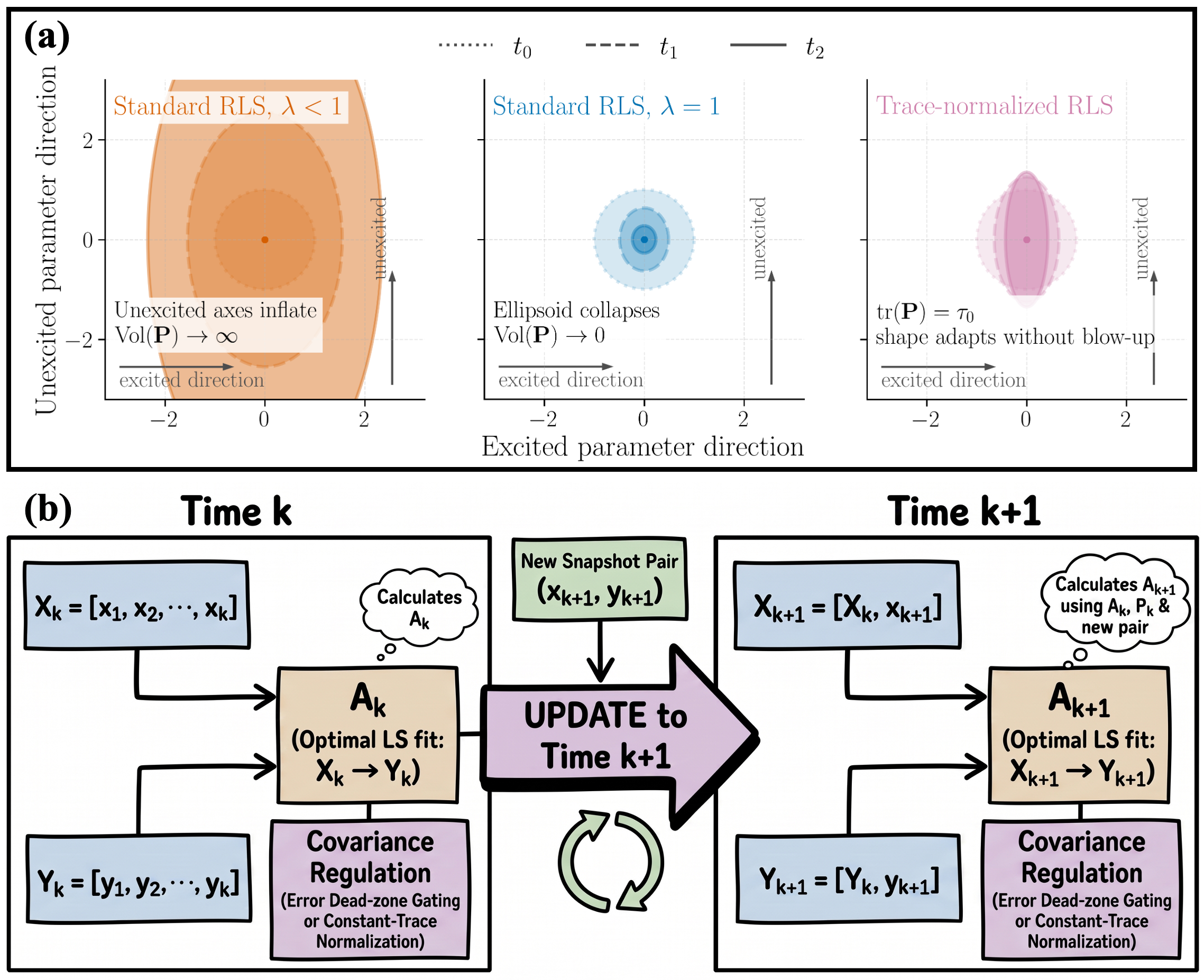
This work develops CR-RKL, a recursive Koopman learning method for nonlinear systems whose dynamics vary over time and fall outside the training distribution. The method updates a lifted linear predictor online while regulating covariance growth and avoiding parameter freezing.
Why This Matters
Robotic systems and autonomous platforms often operate under changing payloads, environments, contact conditions, and aerodynamic effects. Batch-identified models can quickly become stale. This paper studies how Koopman-based predictors can be updated recursively while controlling the uncertainty introduced by new measurements.
Main Contributions
- Proposes a covariance-regulated recursive Koopman learning framework for nonlinear systems with uncertain, time-varying dynamics.
- Introduces two complementary covariance-regulation strategies: error dead-zone gating and constant-trace normalization.
- Addresses two recursive-estimation failure modes: covariance windup under low excitation and vanishing gain without forgetting.
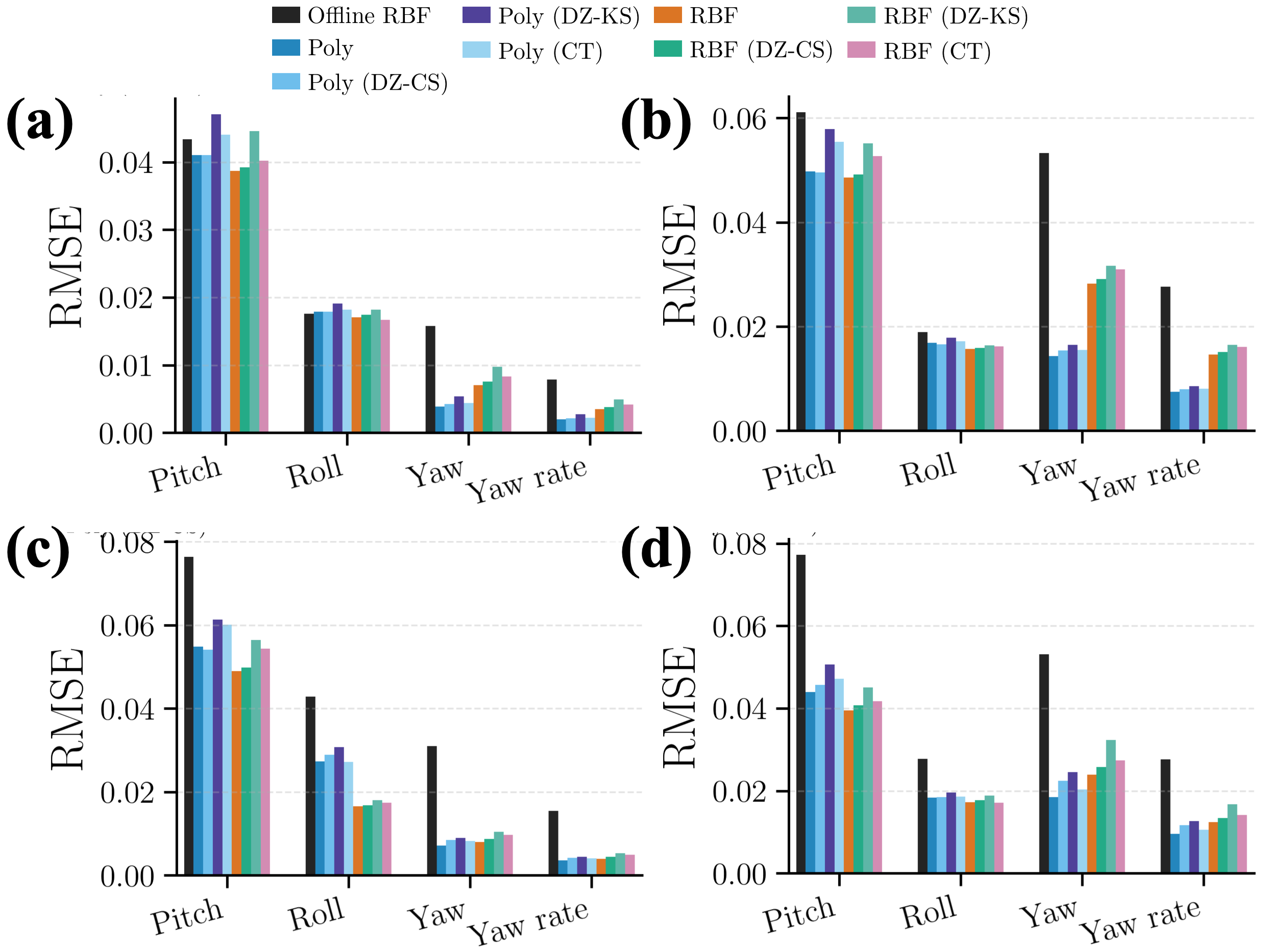
- Validates online modeling on a differential-drive robot with wheel slip and Stribeck friction and on a 26-gram butterfly-inspired flapping-wing robot.
- Embeds the learned model in model predictive control to evaluate closed-loop tracking under uncertain dynamics.
Key Findings
- CR-RKL maintains numerically stable online learning in settings where conventional recursive updates can become ill-conditioned.
- Constant-trace normalization preserves the geometric structure of uncertainty while preventing covariance explosion.
- The approach improves online modeling and supports reliable MPC tracking under uncertain, time-varying dynamics.
Citation
Gu, Weibin, Chen Yang, Lu Shi, and Chao Gao. “Covariance-Regulated Recursive Koopman Learning for Nonlinear Systems with Uncertain Time-Varying Dynamics.” arXiv preprint arXiv:2606.15317 (2026).